

Lithium-ion batteries act as vital “energy reservoirs” and “conversion hubs” within the clean energy landscape. Their manufacturing, however, is far from straightforward. From material synthesis to cell formation, the production workflow involves complex, coupled multiphysics phenomena spanning chemistry, electrochemistry, mechanics, thermodynamics and fluid dynamics. Controlled oxygen injection is required at certain stages of this manufacturing process.
I. Key Processes Involving Oxygen in Lithium-Ion Battery Production
High-Temperature Sintering of Cathode Materials
At elevated temperatures, lithium salts and precursors undergo oxidation and crystallization to form layered cathode oxides. Oxygen partial pressure directly determines the resulting crystal structure, residual alkali content and electrochemical performance. High-nickel cathode materials, in particular, impose the strictest oxygen requirements. By contrast, lithium iron phosphate (LFP) sinters in ambient air and requires no supplemental oxygen supply.
Sintering of ternary cathode materials (such as NCM or NCA) and lithium cobalt oxide (LCO) requires oxygen feed, making these steps major oxygen consumers at battery manufacturing plants.
Principle: Precursors and lithium salts react with O₂ at high temperatures to form layered oxide crystal structures. High-nickel ternary materials are especially sensitive to oxygen partial pressure. Insufficient oxygen triggers the formation of impurity phases, which reduces cell capacity and shortens cycle life.
Preparation of Raw Material Precursors (Wet-Chemical Processing)
During ternary precursor co-precipitation and metal leaching stages: Oxygen is introduced to support pressurized oxidation and wet-chemical leaching, driving metal ions to their target valence states. This improves the quality of precipitated products and boosts metal recovery rates.
Battery Recycling (Pyrometallurgy)
In pyrometallurgical treatment of spent batteries, oxygen-enriched air or pure oxygen is injected to sustain combustion and oxidation. This converts metal salts into oxides, simplifying subsequent metal separation and recovery.
II. Gas Supply Specifications
1. Purity
High-Temperature Sintering of Cathode Materials
• Conventional ternary materials (NCM523/NCM622): ≥93% purity. Vacuum Pressure Swing Adsorption (VPSA) on-site oxygen generation is the industry standard.
• High-nickel NCM811, NCA and lithium cobalt oxide (LCO): Stable purity at 93%–94%. Only a small number of specialized closed static kilns or R&D pilot lines require high-purity oxygen (99.0%–99.5%), which can be supplied by PSA systems fitted with additional purification units.
Preparation of Raw Material Precursors (Wet Process)
Oxygen purity ≥90% is adequate. VPSA on-site oxygen generation is widely adopted; high-purity oxygen is unnecessary. Hydrocarbon specifications are far less stringent than those for sintering operations.
Battery Recycling (Pyrometallurgy)
Oxygen purity: mostly 85%–93% (oxygen-enriched air). VPSA oxygen generation is the preferred, most cost-effective option; high-purity oxygen is not required.
2. Gas Supply Pressure
High-Temperature Sintering of Cathode Materials
Main supply line at the kiln inlet: 0.12–0.25 MPa (gauge pressure). A slight positive pressure is maintained inside the kiln to preserve the required atmosphere.
Preparation of Raw Material Precursors (Wet Process)
0.2–0.4 MPa (gauge pressure), used to bubble oxygen into the slurry within reaction vessels.
Battery Recycling (Pyrometallurgy)
0.2–0.5 MPa (gauge pressure). Oxygen is injected at high pressure through nozzles to enhance turbulence and combustion inside the furnace.
Note: VPSA systems typically deliver oxygen at relatively low pressure (generally 0.03–0.08 MPa). An oxygen booster may be installed if higher pressure is needed. PSA systems run on compressed air feedstock, so oxygen is generated under pressure, suiting applications that demand higher delivery pressure.
3. Gas Supply Modes
High-Temperature Sintering of Cathode Materials
Oxygen is fed continuously at a surplus flow rate to strip water vapor and CO₂ produced during sintering. The kiln is kept under slight positive pressure to prevent ingress of ambient air, which would dilute oxygen concentration.
Preparation of Raw Material Precursors (Wet Process)
Oxygen is introduced via bubbling or microporous aeration for dispersion into the liquid phase. This is a gas-liquid oxidation reaction. Regulating gas flow stabilizes dissolved oxygen levels in the liquid and prevents uneven oxidation that would degrade particle morphology.
Battery Recycling (Pyrometallurgy)
Oxygen is injected into the smelting furnace together with fuel (e.g., coke or natural gas) to strengthen turbulence and combustion, raise furnace temperature and reduce total flue-gas volume.
4. Oxygen Dew Point
Moisture must be rigorously excluded. If moisture enters the kiln, high-temperature conditions accelerate lithium volatilization, powder agglomeration and rising residual alkali levels — all of which harm the cathode material’s electrochemical performance.
Oxygen dew point: ≤ −40 °C Td (at atmospheric pressure). For premium high-nickel production lines, ≤ −50 °C Td is recommended.
Important Considerations:
• PSA Systems: Feedstock is compressed air. With a properly maintained upstream dryer, a dew point of ≤ −40 °C can be consistently achieved. Watch for rapid dew-point rises triggered by dryer malfunction.
• VPSA Systems: These use ambient-pressure air as feedstock. Inlet air filtration paired with a pre-dehumidification unit is required to control incoming humidity. Extra inlet air dehumidification is needed in high-humidity regions (for example, during the plum rain season in southern China). This prevents molecular sieves from adsorbing excessive moisture, which would otherwise cut oxygen output and purity.
III. Advantages of On-Site Oxygen Generation
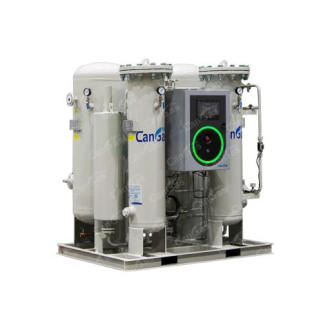
As outlined above, oxygen for lithium-ion battery manufacturing must be delivered continuously and stably while meeting defined purity, flow, pressure and dew-point criteria. Compared with alternative oxygen sourcing such as liquid oxygen procurement or cryogenic air separation, on-site oxygen generation offers these benefits:
• Lower unit oxygen cost: Eliminates expenses for liquid oxygen purchase, transportation and tank management, while reducing exposure to price volatility.
• Higher supply reliability: Continuous on-site oxygen production minimizes shutdown risks caused by supply shortages or logistical delays.
• More manageable capital investment: PSA (Pressure Swing Adsorption) and VPSA systems have shorter construction cycles and simpler layouts than cryogenic air separation plants.
• Flexible capacity scaling: Modular equipment allows additional oxygen generation units to be added to match production line requirements.
• Easier safety administration: Reduces the compliance burden and cryogenic leakage hazards associated with bulk liquid oxygen storage and transport.
IV. Selecting an On-Site Oxygen Generation Solution
High-Temperature Sintering of Cathode Materials
Process Requirements: NCM523 typically requires ≥93% purity; certain specialized processes call for 99–99.5%. Continuous, stable delivery is critical, with no oxygen partial pressure fluctuations.
Selection Strategy:
• Low-to-medium nickel NCM grades (e.g., 523/622): VPSA (90–93% purity) is preferred. Advantage: Supports high flow rates with the lowest specific energy consumption for oxygen; capable of 24/7 continuous operation to match sintering kilns’ steady oxygen demand.
• High-nickel NCM / NCA / Lithium Cobalt Oxide (LCO): PSA + downstream purification (93–94% purity) is preferred. Advantage: High-purity oxygen from PSA plus polishing controls impurities (moisture, CO₂) and safeguards cathode crystal quality.
Preparation of Raw Material Precursors (Wet Process)
Process Requirements: Oxygen concentration ≥90% is sufficient. The key control target is reactor dissolved oxygen; ultra-high purity is unnecessary.
Selection Strategy: VPSA is the first choice. PSA suits smaller production capacities.
• VPSA: Delivers 85–93% purity, fully meeting requirements. It supports high flow at low cost and tolerates impurities well, with no complex polishing needed.
• PSA: Suitable for small-scale precursor lines, though its energy consumption is higher than VPSA.
This stage has the loosest oxygen quality requirements, so selection is driven mainly by cost efficiency.
Battery Recycling (Pyrometallurgy)
Process Requirements: Oxygen-enriched combustion with an excess oxygen coefficient of 1.1–1.5. This process has the highest impurity tolerance, though oxygen consumption varies widely based on feedstock carbon content.
Selection Strategy: Preferred option: VPSA (85–93% purity). PSA can be used for small smelting lines.
• VPSA: Its oxygen enrichment range is an ideal match for pyrometallurgy. It delivers the lowest oxygen unit cost and cuts flue-gas volume, easing the load on exhaust treatment systems.
• PSA: An alternative for small-scale smelting lines, with higher energy use than VPSA at the same flow rate.