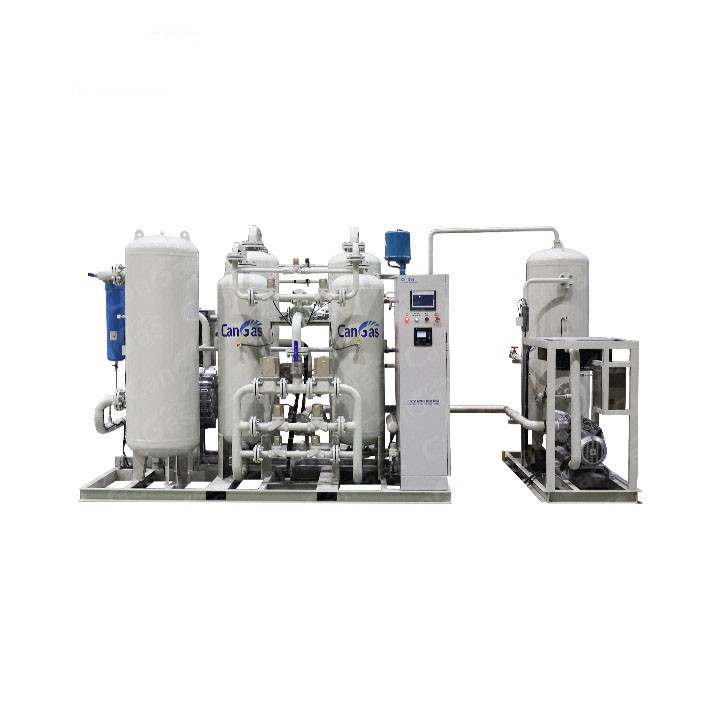

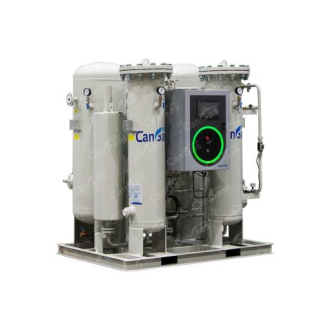
Pressure Swing Adsorption (PSA/VPSA) is a highly efficient technology for separating and recovering CO₂. Its core principle lies in utilizing the selective adsorption characteristics of adsorbents for CO₂ under varying pressure conditions. Below are the specific implementation steps and key technical details:
Working Principle
1. Adsorption Stage:
Under pressurized conditions, a mixed gas containing CO₂ passes through an adsorption tower filled with specialized adsorbents (e.g., molecular sieves). The adsorbent preferentially captures CO₂ molecules, while unadsorbed components (such as nitrogen and oxygen) are discharged from the system, achieving initial separation of CO₂.
2. Desorption and Regeneration Stage:
During depressurization, the adsorbed CO₂ is released from the adsorbent surface, restoring the adsorbent’s activity for reuse. The desorbed high-concentration CO₂ gas can be further compressed, liquefied, stored, or directly utilized.
Process Flow
1. Pretreatment Stage:
● Impurity Removal: Raw gas (primarily industrial flue gas) is washed in a water scrubbing tower to remove soluble organic compounds and acidic gases.
● Drying: Residual moisture and trace impurities are eliminated using desiccants to ensure subsequent adsorption efficiency.
2. Pressure Swing Adsorption Core Operation:
● Multi-Tower Switching Design: Industrial systems typically employ dual or multiple adsorption towers operating in parallel. Continuous production is achieved by cyclically switching each tower between adsorption and desorption phases. When one tower becomes saturated, it transitions to low-pressure desorption mode while another tower enters the high-pressure adsorption stage.
● Automatic Control: A PLC-based system coordinates all operational stages, enabling unattended and efficient process management.
3. Product Collection and Post-processing:
● Compression and Storage: High-purity CO₂ obtained from desorption is pressurized via compressors and stored in gas tanks or condensed into liquid form for transport. For instance, in the brewing industry, this CO₂ is used for food preservation or beverage carbonation.
● Quality Inspection: Online purity analyzers monitor CO₂ quality to ensure compliance with industrial standards.
Key Influencing Factors
1. Adsorbent Selection: Performance depends on high specific surface area, selectivity, and stability (e.g., zeolite 13X or MOFs).
2. Operating Conditions:
● Elevated temperatures weaken physical adsorption, while pressure gradients dictate desorption efficiency.
● Feed gas composition requires tailored pressure swing curves to optimize separation.
● Excessive flow rates may cause premature breakthrough, reducing efficiency.
3. Regeneration Strategy: Countercurrent purging accelerate desorption, minimize residual gas retention, and sustain long-term operational efficacy.
Conclusion
PSA/VPSA technology offers significant advantages for CO₂ recovery, including environmental sustainability, low energy consumption, high product purity, and minimal maintenance costs. It is particularly well-suited for small- to medium-scale applications, delivering both economic and ecological benefits.