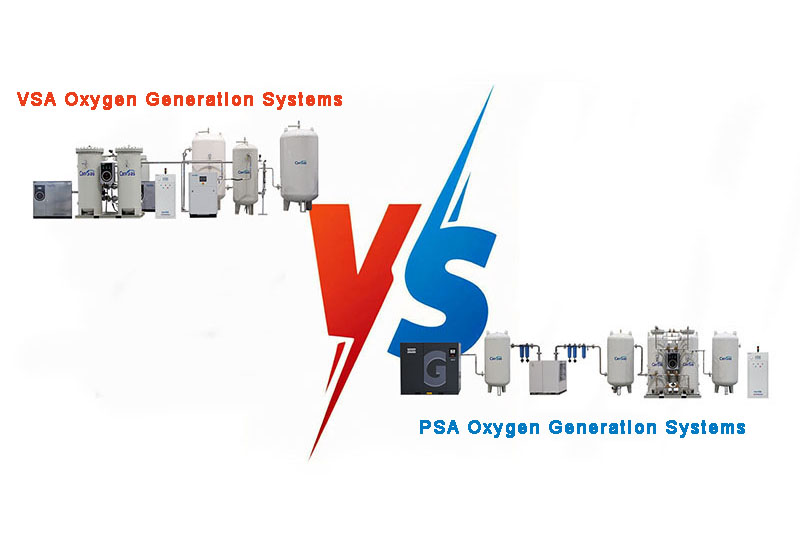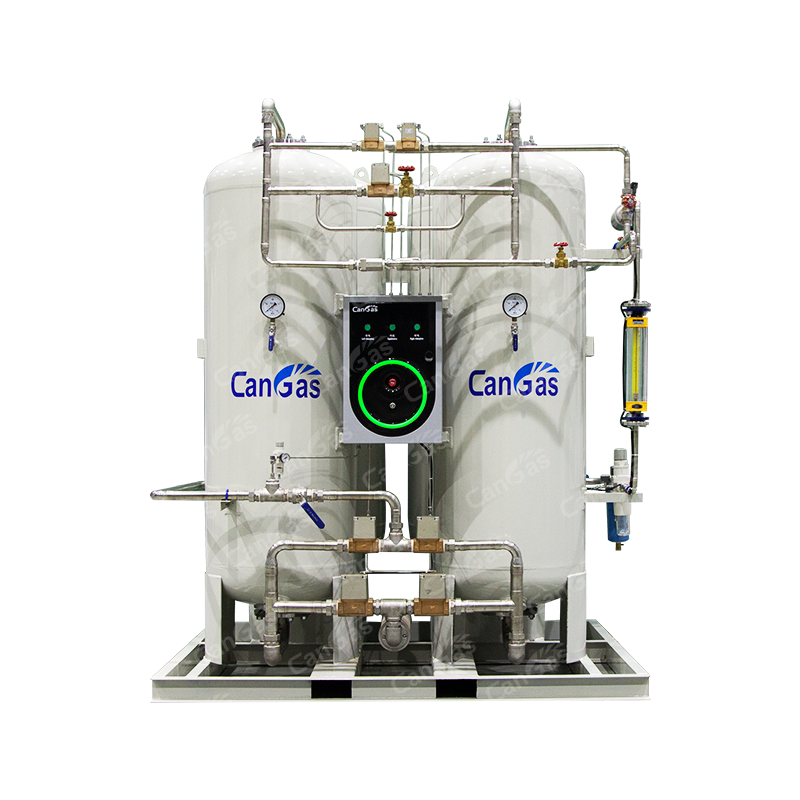

VSA (Vacuum Pressure Swing Adsorption) and traditional PSA (Pressure Swing Adsorption) oxygen generation systems are two types of on-site ambient-temperature air separation technologies. While they share similar working principles, they exhibit distinct characteristics. This article discusses their differences in equipment composition, performance parameters, maintenance, and economic benefits.
Equipment Composition
• Gas Supply:
o VSA systems use blowers and vacuum pumps.
o PSA systems use air compressors.
• Oxygen Generator:
o VSA adsorption towers have a smaller height-to-diameter ratio with high-efficiency molecular sieves, resulting in a more compact design.
o PSA adsorption towers have a larger height-to-diameter ratio and typically use sodium-based molecular sieves, leading to taller structures.
• Water Removal:
o VSA systems do not require dryers or refrigerated dryers.
o PSA systems require dryers for the adsorption towers.
• Instrument Air:
o VSA systems include a separate instrument air system.
o PSA systems draw instrument air directly from the main pipeline.
Performance Parameters
• Working Pressure:
o VSA operates at -50 to +55 kPa (sub-atmospheric to slight positive pressure).
o PSA operates at 0–0.6 MPa (high-pressure range).
• Gas Purity:
o Both systems achieve >90% oxygen purity, adjustable based on requirements.
• Energy Consumption:
o PSA consumes over twice the energy of VSA. The energy-saving advantage of VSA becomes more significant at larger gas output scales.
• High-Altitude Applicability:
o VSA performance is less affected by high altitudes.
o PSA efficiency declines noticeably at high altitudes.
• Oxygen Production Capacity:
o VSA supports large-scale industrial oxygen production.
o PSA is suited for small-to-medium-scale applications.
Maintenance
• VSA Systems:
Scroll blowers have a simple, durable structure, requiring only periodic replacement of intake filters.
• PSA Systems:
Require regular replacement of filter elements, oil changes, and maintenance of lubrication systems.
Economic Benefits
• VSA:
Higher initial investment but lower maintenance and energy costs. Economic advantages are pronounced in long-term operations or high-altitude deployments.
• PSA:
Lower initial investment but higher operational and maintenance expenses.
In summary, both systems have trade-offs in application scenarios, site conditions, and economics. Users should select based on specific needs, prioritizing factors like scale, location, and total lifecycle costs.