
Can PSA Oxygen Generation Systems Enhance the Safety and Refined Management of Medical Gas Systems
As an efficient and safe technology for medical oxygen supply, Pressure Swing Adsorption (PSA) oxygen generation systems offer significant advantages in promoting the safety and refined management of medical gas systems. These advantages are specifically reflected in the following aspects:
I. Enhanced Safety
1. Technical Safety
· PSA oxygen generation systems use ambient air as raw material and employ a physical separation process, requiring no chemical additives.
· By generating oxygen on-site, PSA systems eliminate the risks of explosion and contamination associated with the transportation of traditional liquid oxygen or cylinder-based oxygen.
· The systems feature a high degree of automation and support remote control capabilities, allowing real-time monitoring of oxygen purity, flow rate, and pressure. This ensures that the quality of the oxygen supply remains stable, safe, and controllable.
· Equipment operation requires only electrical power, thereby reducing management costs and mitigating fire hazards.
2. Fire and Electrical Safety
· PSA equipment rooms typically must comply with Class B fire safety standards, using fire-resistant materials, independent room layouts, and isolation via Class A fire-rated doors.
· Design features such as independent power distribution cabinets and lightning protection grounding systems further minimize the risk of electrical faults.
3. Regulatory Compliance
PSA equipment must adhere to national standards-such as the Code for Design of Lightning Protection for Buildings and the Technical Specification for Medical Gas Engineering-to ensure that site selection, installation, and operation and maintenance (O&M) activities comply with regulations.
II. Promoting Refined Management
1. Intelligent Monitoring and Remote Management
· Leveraging sensors and PLC controls, the system achieves a high level of automation, effectively preventing human operational errors while enabling real-time monitoring of parameters such as oxygen flow rate, pressure, and purity, thereby ensuring the stability of the oxygen supply quality.
· Remote monitoring technology assists medical staff in improving emergency response efficiency, making it particularly suitable for use during epidemic outbreaks or in scenarios involving large-scale oxygen demand.
2. Modular and Integrated Design
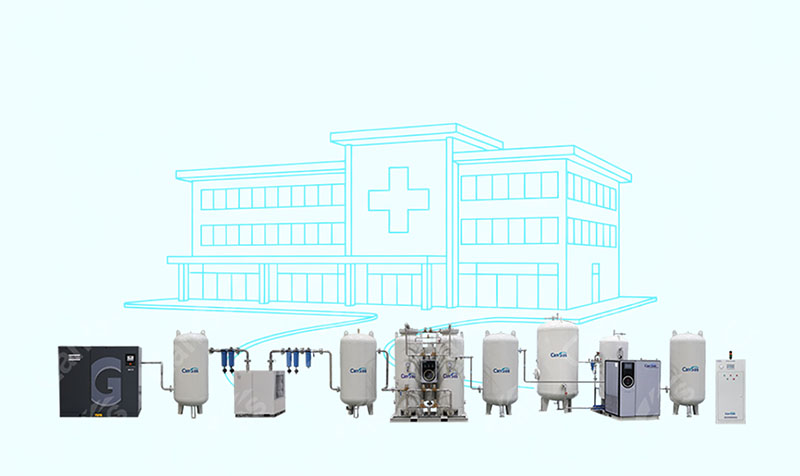
· Integrated PSA systems optimize space utilization and facilitate efficient, collaborative management.
· The integrated design of the oxygen generation and supply systems (e.g., a centralized oxygen supply model) enables on-demand oxygen distribution, thereby preventing waste and simplifying O&M procedures.
3. Convenient O&M and Cost Control
· PSA equipment can generate oxygen strictly on an "as-needed" basis, thereby reducing unproductive operating time.
· System maintenance costs are lower than those of traditional liquid oxygen or cylinder-based systems, as there is no need for frequent cylinder inspections, storage tank cleaning, or similar tasks.
· Mechanisms for equipment fault pre-warning and routine maintenance (such as filter replacement) can further enhance system reliability.
III. Scenario Adaptability and Scalability
1. Diverse Application Scenarios
· From fixed-site, high-capacity oxygen supply (central hospital oxygen systems) to mobile emergency oxygen supply (vehicle-mounted units, modular field hospitals, etc.), PSA technology meets the demands of various scenarios, thereby enhancing the flexibility and resilience of healthcare systems.
· Remote regions-such as mountainous and high-altitude areas-can utilize mobile PSA equipment to generate oxygen on-site, effectively addressing the shortcomings of traditional supply chains.
2. Data-Driven Optimization
Operational data accumulated through remote monitoring and intelligent systems can be used to analyze oxygen consumption trends and optimize equipment scheduling, driving a shift in management paradigms from "experience-driven" to "data-driven."
Challenges and Countermeasures
· Technical Dependency: PSA systems are highly dependent on electrical power and equipment stability; therefore, backup power sources and emergency response plans are essential.
· Operational Expertise: Personnel involved with the equipment require specialized training to ensure proper operation and maintenance procedures are followed.
· Initial Investment Costs: Although long-term operating costs are low, the upfront costs for equipment procurement and installation are relatively high; thus, planning must be carefully aligned with the hospital's specific operational requirements.