
PSA ambient-temperature air separation system: Why Dew Point Monitoring Is Essential
Ambient air contains invisible moisture, commonly known as water vapor. While appropriate humidity is harmless to human comfort, abnormally high or low humidity can cause physical discomfort. However, for Pressure Swing Adsorption (PSA) air separation equipment, atmospheric moisture is regarded as a harmful contaminant. Excess moisture leads to pipeline corrosion, low-temperature freezing, and accelerated component wear. To eliminate moisture-related impacts on gas quality and operational stability, the dew point parameter is adopted to accurately monitor gas moisture content.
Simply defined, the dew point (°C) is the temperature at which water vapor in the gas reaches saturation and condenses into liquid water under a fixed pressure. It serves as a direct indicator of moisture concentration: a lower dew point corresponds to lower gas moisture content, whereas a higher dew point indicates higher humidity.
Core Benefits of Dew Point Monitoring
1. Prevents Equipment Damage and Unexpected Failures
Residual moisture accumulating in gas pipelines can deactivate molecular sieves and cause pipeline corrosion, directly deteriorating the purity of produced nitrogen and oxygen. Real-time dew point monitoring effectively avoids unplanned downtime and frequent maintenance, ensuring continuous and stable equipment output.
2. Protects Downstream Processes and Product Quality
Excessive gas moisture adversely affects various industrial production scenarios. In metallurgical processes, humid process gas changes furnace internal humidity and compromises finished metal quality. In pharmaceutical production, residual moisture causes powder agglomeration and insufficient drying. For all high-purity gas applications, moisture is a critical contaminant, making continuous dew point monitoring indispensable.
3. Improves Energy Efficiency
A low dew point indicates low gas moisture content, which reduces the operational load on drying systems. By monitoring dew point data, the regeneration cycles of adsorption dryers can be dynamically adjusted, avoiding ineffective energy consumption and lowering overall operating costs.
4. Ensures Industrial Compliance and Operational Safety
Major industrial standards, including ISO and GMP, specify clear dew point requirements for process gas. Qualified dew point values ensure production compliance. In flammable and explosive environments such as hydrogen and biogas systems, stable low dew point conditions prevent chemical reactions induced by moisture, eliminating potential safety hazards.
Standard Dew Point Requirements for PSA Systems
For conventional PSA nitrogen and oxygen generators, the standard dew point of finished gas is required to be below -40°C. For high-purity and ultra-dry gas applications, the dew point threshold can be tightened to -60°C or lower.
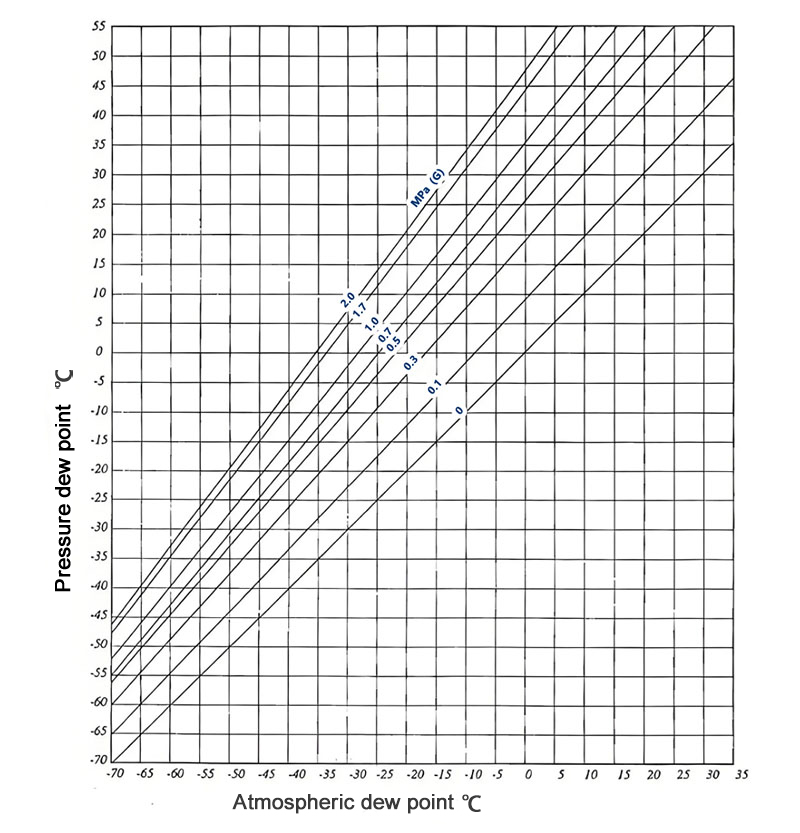
Atmospheric Dew Point vs. Pressure Dew Point Conversion
PSA air separation equipment operates based on compressed air. Since system operating pressures vary across different working conditions, conversion between atmospheric dew point and pressure dew point is necessary, as dew point values change significantly with pressure fluctuations.
For example: Compressed air at 0.7 MPa with a pressure dew point of 2°C corresponds to an atmospheric dew point of -23°C. When the pressure rises to 1.0 MPa while the pressure dew point remains 2°C, the corresponding atmospheric dew point drops to -28°C.
This rule indicates that with a constant pressure dew point, increased operating pressure results in a lower atmospheric dew point. The conversion relationship between atmospheric dew point and pressure dew point can be referenced in the corresponding conversion chart.