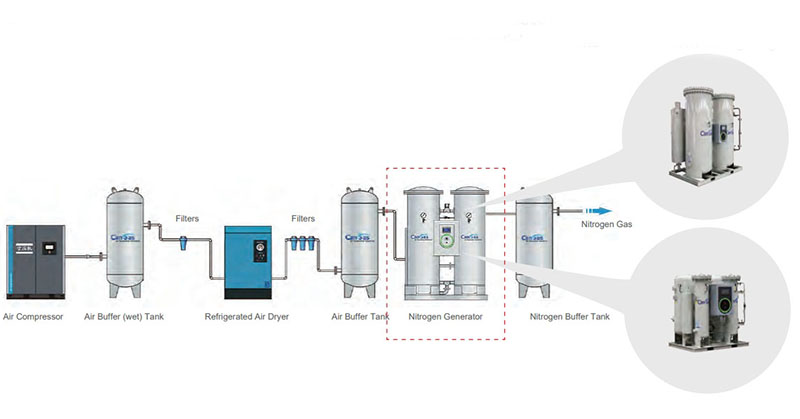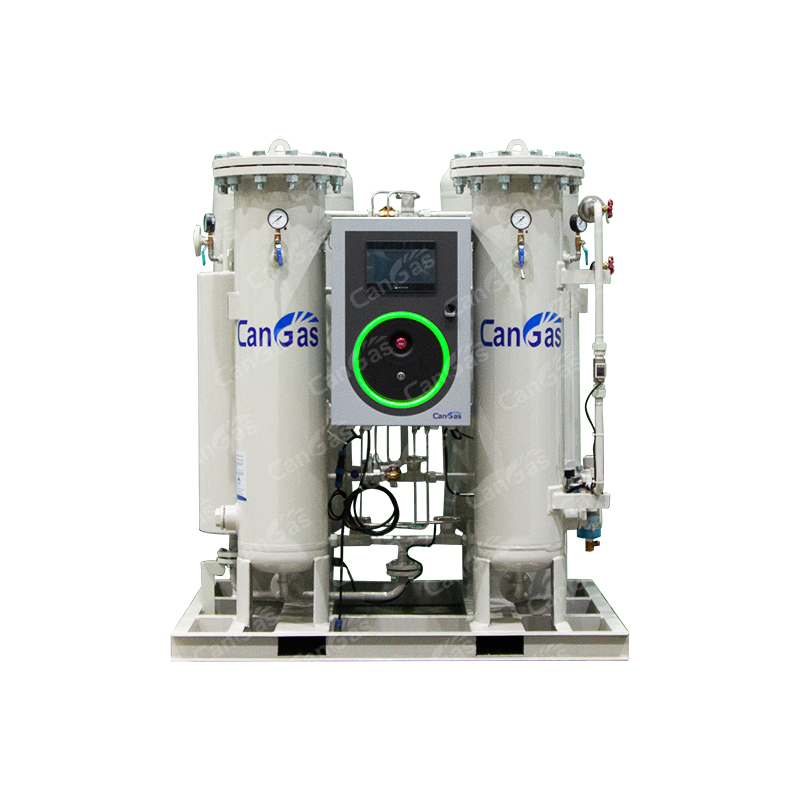

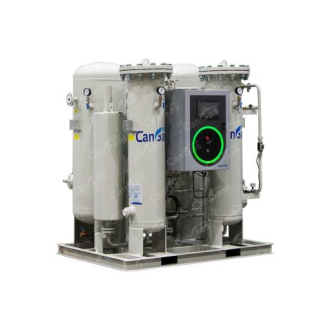
The Pressure Swing Adsorption (PSA) nitrogen generation system is a widely used, safe, efficient, and stable on‑site nitrogen supply solution. Based on the principle of pressure swing adsorption for air separation, it comprises four main subsystems: the air pretreatment system, the adsorption and separation system, the control and intelligent system, and the nitrogen post‑treatment system.
1. Air Pretreatment System
System components: Air compressor + Refrigerated dryer + Filters
· Air compressor – responsible for compressed air supply
Function: Provides a source of pressurized air.
Role: Pressurizes ambient air to the required operating range and delivers a stable, pressurized airflow to the subsequent adsorption and separation stage.
· Refrigerated dryer
Function: Cools the compressed air via a refrigeration cycle to condense and remove water vapor, thereby achieving thorough drying of the compressed air.
Role: Effectively enhances overall system stability and ensures product nitrogen quality. Additionally, it dampens airflow pulsations generated by the air compressor, allowing for a smoother air feed into the adsorption towers.
· Filters
Function: Trap impurities, oil vapors, and residual water from the air, making the compressed air drier and cleaner.
Role: Significantly reduce the content of impurities, oil, and moisture in the compressed air; effectively extend the service life of the molecular sieve; guarantee product nitrogen quality; and lower system operation and maintenance costs.
2. Adsorption and Separation System
System components: Adsorption towers + Adsorbent (carbon molecular sieve)
· Adsorption towers
Function: The core separation unit, typically designed as a dual‑tower configuration that operates alternately to ensure continuous gas supply. The towers are usually made of stainless steel or carbon steel with an anti‑corrosion coating.
Role: After pretreatment, compressed air enters the left adsorption tower. As the pressure inside the tower rises, oxygen molecules in the air are adsorbed by the carbon molecular sieve, while the unadsorbed nitrogen passes through the adsorption bed and flows into the nitrogen storage tank. This process is referred to as "left‑side adsorption" and lasts for several tens of seconds.
Upon completion of left‑side adsorption, the pressures in the left and right towers are equalized (a step that takes approximately 2–3 seconds). After equalization, compressed air enters the right tower; oxygen molecules are again adsorbed, and the nitrogen‑enriched gas flows to the storage tank. Simultaneously, the left tower initiates a depressurization and desorption cycle: previously adsorbed oxygen is vented to the atmosphere through an exhaust valve, regenerating the adsorbent. To enhance desorption, a continuous back‑purge gas stream flows in the reverse direction through the left tower, ensuring complete removal of residual oxygen. This back‑purging occurs concurrently with the desorption process. Once the right tower’s adsorption cycle is finished, the system repeats the pressure‑equalization step and switches back to left‑tower adsorption, creating a continuous production cycle.
· Adsorbent – Carbon Molecular Sieve (CMS)
Function: A porous carbon‑based adsorbent material designed for gas separation, featuring high compressive strength and wear resistance.
Role: CMS is the critical material that determines separation efficiency. Its microporous structure allows smaller N₂ molecules to pass through rapidly while trapping larger O₂ molecules. By exploiting the difference in adsorption affinity for nitrogen and oxygen, it enables highly efficient gas separation.
3. Control and Intelligent Systems
System components: Pneumatic valve system + Control system + Human‑Machine Interface (HMI)
· Pneumatic valve system
Function: Includes solenoid valves, check valves, pressure relief valves, etc. These typically feature millisecond‑level actuation, reliable sealing, and adaptability to varying pressures and temperatures.
Role: Manages key operational steps such as tower switching, pressure equalization, and desorption. It directly impacts the overall operational efficiency, stability, and reliability of the system, serving as the core actuation unit of the nitrogen generator.
· Control system (PLC)
Function: Optimizes energy consumption via dynamic balancing algorithms; performs fault self‑diagnosis and alarm logging; enables historical data tracking and analysis.
Role: The Programmable Logic Controller (PLC) forms the basis of system automation and acts as the "brain" of process control. It coordinates equipment operation and monitors parameters such as pressure, flow rate, and purity in real time, providing the data support necessary for full lifecycle management, intelligent manufacturing, and automated operations.
· Human‑Machine Interface (HMI)
Function: Serves as the bridge between the operator and the equipment; visualizes operations to enhance monitoring efficiency and simplify maintenance.
Role: Operators can complete 90% of routine tasks within three clicks. Key parameters are displayed on the screen, and the system automatically logs core metrics and operational activities to create a historical record.
Remote monitoring and data analysis capabilities eliminate the need for on‑site personnel: using communication protocols, the HMI uploads operational data to an online platform, allowing system managers to view real‑time equipment status and metrics via a mobile app. A built‑in maintenance reminder feature increases the proportion of preventive maintenance, potentially reducing annual maintenance costs by approximately one‑third.
4. Nitrogen Post‑Treatment System
System components: Nitrogen buffer tank + Point‑of‑use purification + Purity enhancement
· Nitrogen buffer tank
Function: Stores a specific volume of compressed nitrogen.
Role: On one hand, the buffer tank mitigates airflow fluctuations caused by the periodic switching of adsorption towers, ensuring continuous and stable nitrogen supply to downstream processes. On the other hand, it accommodates sudden demand spikes or fluctuations resulting from equipment startup and shutdown.
· Point‑of‑use purification
Function: Employs multi‑stage filtration and dew‑point control processes to further purify the nitrogen by removing moisture and impurities.
Role: Provides additional filtration and purification to minimize residual moisture, impurities, and oil content.
· Purity enhancement
Function: Reduces oxygen content in the product gas via oxidation reactions to further increase nitrogen purity.
Role: Achieves high‑purity nitrogen production through two technical pathways: catalytic purification and hydrogen‑based purification. Notably, for applications requiring purity levels exceeding 99.9995%, the hydrogen‑based method offers greater stability than catalytic purification.