
Biogas is derived from the anaerobic decomposition and fermentation of organic matter; it is abundant and widely available.
Biogas recovery and utilization primarily focus on purifying and reusing its main component—methane (which accounts for 35–65% of the gas). This process involves removing impurities and CO₂ to increase the methane concentration to levels meeting natural gas or vehicle fuel standards (CH₄ > 95% or 97%); the purified methane can then serve as a renewable energy source, replacing conventional natural gas.
In fact, as nations actively pursue "low-carbon, circular" production goals, accelerating the upgrading of biogas to biomethane has become a widely shared international consensus.
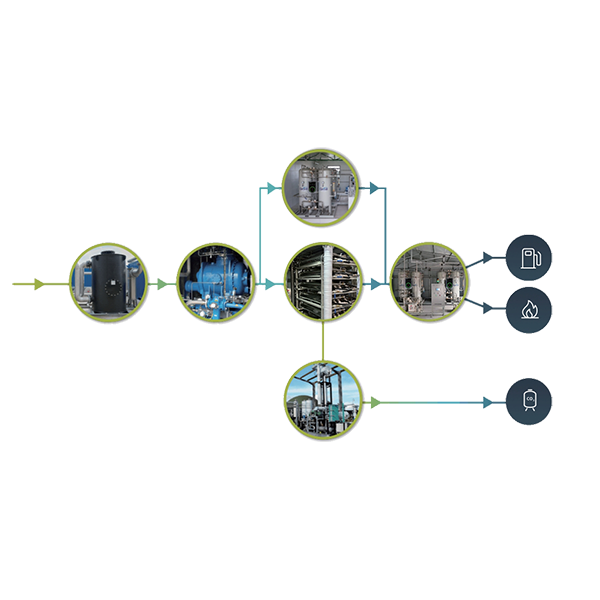
Biogas purification involves several stages, such as desulfurization, deoxygenation, dehydration, decarbonization, and denitrogenation. The methods applicable to each stage are outlined below:
1. Desulfurization
Biological Desulfurization
A small amount of air (approximately 2–6%) is injected into the biogas pipeline or a biological desulfurization tower, where aerobic microorganisms oxidize H₂S into elemental sulfur (S) or sulfates (SO₄²⁻).
Dry Desulfurization
Biogas is passed through an adsorption tower packed with iron oxide or zinc oxide. H₂S reacts with the packing material to form iron sulfide or zinc sulfide.
Wet Desulfurization
Alkaline solutions, such as sodium hydroxide (NaOH) or amine solutions, are used to absorb H₂S. The absorbing solution can be chemically regenerated, and sulfur can be recovered.
Physical Absorption
Organic solvents, such as polyethylene glycol, are used to absorb H₂S under high pressure; the gas is released when the pressure is reduced.
Among the methods mentioned above, biological desulfurization is currently the mainstream technology and is considered a low-cost, environmentally friendly option. Dry desulfurization requires simple equipment and low investment, making it suitable for small-to-medium-scale operations with low H₂S concentrations. Wet desulfurization offers high treatment efficiency and is suitable for large-scale biogas projects with high H₂S concentrations.
2. Catalytic Deoxygenation
This process uses a catalyst (typically a precious metal such as palladium or platinum) to facilitate a reaction between trace oxygen (O₂) in the biogas and methane (CH₄) or hydrogen (H₂), producing carbon dioxide (CO₂) and water (H₂O).
Key reactions:
CH₄ + 2O₂ → CO₂ + 2H₂O
2H₂ + O₂ → 2H₂O (the reaction proceeds more easily if additional hydrogen is introduced)
This method operates at temperatures between 200°C and 500°C and can reduce oxygen concentration to below 10 ppm; it is a mature deoxygenation technology in the chemical and natural gas industries. However, it results in some loss of methane and generates additional CO₂ and water; furthermore, the catalysts are expensive, and the process places high demands on the upstream desulfurization stage.
3. Dehydration
Condensation Dehydration (Most Common Method)
The biogas temperature is lowered using a condenser, causing water vapor to condense and separate. This method includes two types: indirect cooling and direct cooling.
• Indirect cooling: Uses a heat exchanger; energy consumption is relatively low.
• Direct cooling: Involves direct contact cooling with chilled water or refrigerant; dehydration efficiency is higher.
Adsorption Dehydration
Uses the Temperature Swing Adsorption (TSA) process. Under specific adsorption pressure, the feed gas passes through an adsorption tower at ambient temperature, and the water vapor within the gas is captured by the adsorbent. Once the adsorbent reaches saturation, it is regenerated via heating; after regeneration is complete, the system proceeds to the next adsorption cycle.
4. Carbon Dioxide Removal
Pressure Swing Adsorption (PSA) for Decarbonization
This method exploits the differences in adsorption affinity between impurity gases (such as CO₂ and H₂S) and methane on the surface of specific adsorbents (e.g., activated carbon or zeolite molecular sieves). During the pressurized adsorption phase, impurities are captured by the adsorbent while methane passes through. Once the adsorbent is saturated, the pressure is reduced to desorb the impurities and regenerate the adsorbent; following regeneration, the system is ready for the next PSA cycle.
Membrane Separation for Decarbonization
This method achieves separation by exploiting differences in the dissolution and diffusion rates of various gas components within the membrane material; it offers rapid startup/shutdown capabilities and low energy consumption.
Both methods mentioned above impose strict requirements on feed gas pretreatment, necessitating deep desulfurization, dehydration, and impurity removal to prevent damage to membranes or adsorbents. Additionally, the decarbonization process entails some loss of methane; specifically, membrane separation requires a multi-stage membrane design to minimize such losses. Both adsorbents and membranes have finite service lives and require replacement upon expiration.
5. Nitrogen Removal
Pressure Swing Adsorption (PSA) for Nitrogen Removal
Separation is achieved by utilizing the differences in adsorption capacities of various gas components (oxygen, nitrogen) on adsorbents (such as carbon molecular sieves or zeolite molecular sieves like Li-LSX).
PSA nitrogen removal technology can simultaneously remove CO₂, O₂, H₂O, and a portion of N₂, yielding product gas with a methane purity of 96%–99%.
Constructing the Optimal Process Chain
Selecting the best biogas recovery and purification scheme requires a detailed techno-economic comparison:
• Analysis and Diagnosis: Fully understand the feed gas composition and define product specifications.
• Determining the Core Process: Based on processing scale, investment, and operating costs, determine the technical route for the core decarbonization step (e.g., PSA or membrane separation).
• Designing Pretreatment: Design upstream dehydration and desulfurization schemes tailored to the requirements of the core technology.
• Evaluating Post-treatment: Assess the need for deoxygenation and nitrogen removal. Issues regarding oxygen and nitrogen content are often more pronounced when the biogas originates from landfills.
• System-wide Optimization: Review the synergy of the entire process—for instance, placing desulfurization before dehydration can prevent pipeline corrosion, while heat generated during compression can be utilized in regeneration steps.