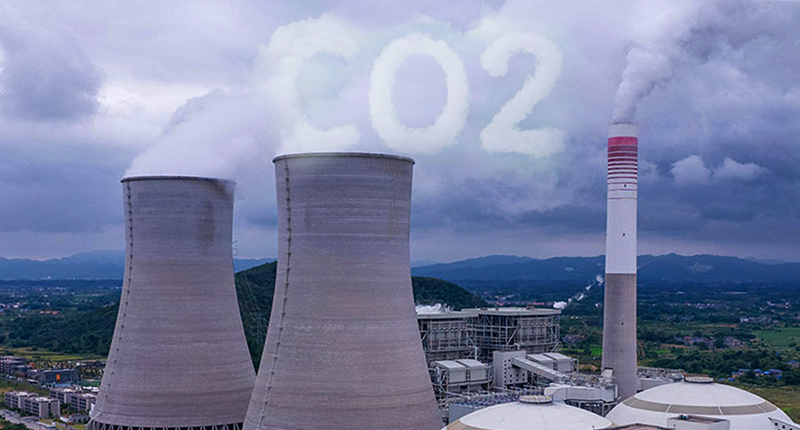

In industrial sectors, exhaust gases emitted by power plants, boiler facilities, lime kilns, and cement plants typically contain 8–35% CO₂. To enable resource recovery, the CO₂ within the raw gas can be captured and purified.
CO₂ capture and purification carry significant environmental and economic implications, and a variety of processes exist for this purpose. In practical applications, factors such as raw gas concentration, processing scale, and economic viability must be comprehensively evaluated to select the most suitable solution for efficiently capturing and purifying CO₂ from complex gas streams. Three common CO₂ purification processes are described below:
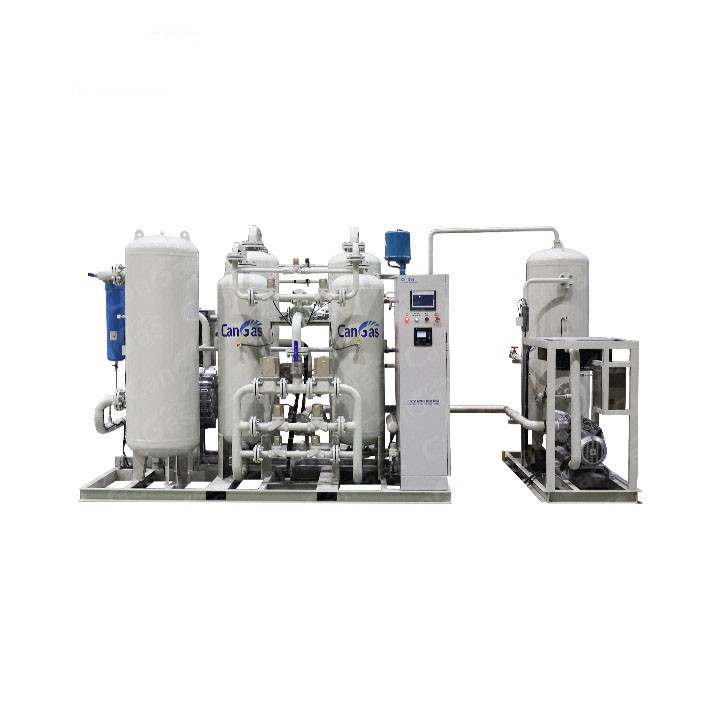
1. Pressure Swing Adsorption (PSA) Purification
This process utilizes an adsorbent (molecular sieve) to selectively adsorb CO₂ at varying pressures—adsorption under high pressure and desorption under low pressure—thereby achieving CO₂ separation and enrichment.
Process Flow
The raw gas undergoes desulfurization and cooling before being pressurized. The CO₂ in the gas is then adsorbed by the molecular sieve, while gases such as N₂, H₂, and CH₄ pass through the adsorption bed, resulting in the separation of CO₂.
Characteristics
This method places high demands on raw gas pretreatment; impurities such as moisture and particulates must be removed to prevent compromising adsorbent performance. Single-stage PSA can yield CO₂ with a purity of 70–90% (adjustable), while multi-stage PSA combined with membrane technology can be employed to meet diverse operational requirements.
2. Chemical Absorption Purification
This process employs a chemical solvent (amine solution) that reacts with CO₂ to form an unstable salt:
R-NH₂ + CO₂ + H₂O ⇌ R-NH₃⁺ + HCO₃⁻
Subsequently, the reaction is reversed by raising the temperature, releasing the CO₂ and thereby achieving separation.
Process Flow
The raw gas undergoes cooling, dedusting, and desulfurization. Then, a "lean solution" (a regenerated solution with high absorption capacity) reacts with the CO₂ in the pretreated gas to form an unstable salt; the resulting CO₂-laden solution (commonly referred to as "rich solution") then flows out from the bottom of the absorption tower. Subsequently, the "rich solution" is heated to 100–120°C. This reverses the chemical reaction, releasing the captured CO₂ and yielding a high-purity CO₂ gas stream. The solution, now stripped of CO₂, regains its absorption capacity and reverts to a "lean solution," ready to enter the next absorption cycle.
Characteristics
This method offers high selectivity, reacting specifically with CO₂ to enable efficient capture even from gas mixtures with low CO₂ concentrations (10–15%). However, the regeneration process requires significant thermal energy (steam), resulting in high overall energy consumption. Additionally, impurities in the flue gas—such as oxygen—can cause amine degradation, thereby increasing operating costs and environmental impact.
3. Low-Temperature Fractionation Purification Process
A method that separates CO₂ by exploiting the differences in boiling points among the various components of the feed gas, utilizing low-temperature condensation and fractional distillation.
Process Flow
The feed gas (e.g., flue gas from coal-fired power plants or tail gas from chemical plants) is compressed and pre-treated to remove impurities such as moisture, sulfides, and nitrogen oxides. The gas is then cooled; components with higher boiling points (primarily CO₂) condense into liquid, while those with lower boiling points (such as N₂ and O₂) remain in the gaseous state. The resulting gas-liquid mixture is fed into a "fractionation column" (or distillation column). Through repeated stages of condensation and evaporation within the column, high-purity liquid CO₂ is ultimately recovered from the bottom.
Characteristics
While this method entails high energy consumption, it yields extremely high-purity CO₂. It is suitable for processing large volumes of feed gas and is ideal for applications where the simultaneous recovery of resources such as nitrogen (N₂) is required.